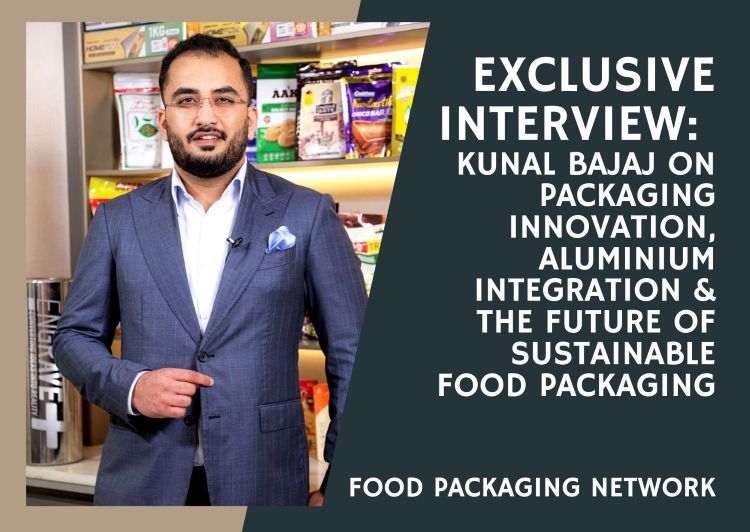
In an exclusive interview with Food Packaging Network, Mr. Kunal Bajaj, Promoter, Jupiter Group, discusses the company’s evolution into one of India’s most integrated packaging and aluminium manufacturers. He highlights how backward integration, advanced retort packaging, high-barrier flexible laminates, and precision aluminium solutions are enabling brands to meet the growing demand for ready-to-eat, shelf-stable, and preservative-free foods. Mr. Bajaj also shares Jupiter Group’s strong commitment to sustainability through recyclable packaging, eco-friendly materials, renewable energy, and resource-efficient manufacturing, while emphasizing that innovation, quality, and complete supply chain control are positioning the company as a trusted global partner for the future of food packaging.
Q1. Jupiter Group has evolved into a fully integrated packaging and aluminium manufacturing ecosystem. Could you take us through your journey, key milestones, and the strategic vision driving your growth in India’s packaging sector?
KB: What started in 2003 as a modest converting machine manufacturer has today evolved into India’s most comprehensively backward-integrated flexible packaging ecosystem. The growth has been intentional and layered by 2008 we had world-class metallizing and holography capabilities, followed by our Films Division with CPP and PE lines, then in-house inks, adhesives and rotogravure cylinders, and eventually retort-grade food packaging.
Each milestone was a building block. Today, our state-of-the-art manufacturing facility at Sonipat houses printing, lamination, extrusion lines, films, cylinders and chemical divisions all delivering international-standard outputs with global acceptance.
That integration journey found its natural conclusion with JUPALCO, our aluminium rolling arm, which seamlessly feeds our foil finishing operations and carries an extendable capacity of 1,20,000 metric tonnes annually. Meanwhile, our flexible packaging capacity has grown from 500 to 1,800 metric tonnes per month.
Serving FMCG, healthcare, pharmaceuticals, pet care and industrial sectors globally, we have built a self-reliant ecosystem that is genuinely difficult to replicate and sustainability remains at the heart of everything we build next.
Q2. India’s food consumption landscape is being reshaped by D2C brands and quick commerce. How is this shift accelerating demand for advanced solutions such as retort and shelf-stable packaging, and how is Jupiter Group positioned to support this transformation?
KB:The rise of D2C brands and quick commerce has fundamentally redefined what packaging must deliver convenience, shelf stability, zero compromise on taste and absolutely no cold chain dependency. Retort packaging sits right at the intersection of all these demands.
Through FoodPro Packaging, India’s No.1 trusted retort grade packaging partner, we offer a comprehensive range purpose-built for this new consumption reality from microwavable pouches and rice-based food packaging to beverages, baby food, pet food and even army rations requiring exceptionally long shelf life.
Our solutions eliminate preservatives while retaining taste, aroma and freshness — exactly what today’s discerning consumer expects. Having already eliminated India’s dependency on imported retort packaging, we now serve the largest retort grade market across India and the South Asian region, and are expanding to Europe and US markets.
Q3. With the rise of clean label products and the demand for preservative-free foods, how is packaging technology evolving to ensure extended shelf life while maintaining product safety and freshness?
KB:The clean label movement has fundamentally shifted where the responsibility of preservation lies it has moved from the formulation lab to the packaging design table, and that is where we thrive.
When a brand removes artificial preservatives, the packaging must work harder and smarter. At Jupiter, we engineer high-performance multilayer structures precisely combining aluminium foil, specialty films and advanced coatings that create impenetrable barriers against oxygen, moisture and light, the three silent destroyers of freshness.
Retort and aseptic technologies further allow thermal sterilization without compromising pack integrity, extending shelf life across ready-to-eat foods, dairy and pet nutrition. We are also integrating active packaging solutions that manage the internal environment of the pack, preserving taste and nutrition without touching the product itself.
And critically, all of this innovation runs parallel to our sustainability commitments food-safe inks, solvent-free adhesives and recyclable structures ensure that clean label products are supported by equally responsible packaging. In essence, as formulations become cleaner, packaging must become more intelligent and at Jupiter, that intelligence is built in by design.
Q4. Sustainability is no longer optional but a necessity. How is Jupiter Group investing in research and development to create recyclable high-barrier laminates that deliver both environmental responsibility and performance?
KB:The biggest myth in our industry is that high-barrier performance and recyclability are mutually exclusive dismantling that is precisely where our R&D is focused.
We are ready with mono-material solutions across PP/PP, MDOPE/PE and rPET structures that deliver genuine barrier performance while being fully compatible with modern recycling streams. On inks, our transition to non-toluene, non-ketone inks, PU-based and water-based systems developed in close collaboration with brand owners and raw material suppliers is actively reducing VOCs and ink GSMs while making our laminates significantly more recyclable.
But sustainability at Jupiter goes well beyond materials. We have invested in solar energy installations across our manufacturing facilities, reducing our grid dependency meaningfully. Our water conservation and drip irrigation systems across plant premises reflect our commitment to responsible resource utilisation. The switch to biofuel for thermic fluid boilers and LPG for generators has further reduced our operational carbon footprint.
My vision for flexible packaging is clear the industry must move from compliance-driven sustainability to design-driven sustainability, where every layer, every ink, every adhesive is chosen with the planet in mind. At Jupiter, that future is not on the roadmap it is already on the shop floor.
Q5. Backward integration has become a key differentiator in today’s supply chain-driven market. How does managing the entire value chain from raw materials to finished packaging help Jupiter Group deliver consistency, reliability, and innovation to food brands?
KB:When a brand trusts you with their packaging, they are trusting you with their product, their consumer and ultimately their reputation. That trust demands consistency and consistency at scale can only be guaranteed when you control every variable in the value chain.
At Jupiter, we do exactly that. Every critical input gravure cylinders through EngravePlus, inks and adhesives through Inkofix, CPP and PE films through our Films Division, and aluminium foil through LSKB is manufactured in-house, to international standards, under one integrated roof.
What makes this genuinely powerful is that each vertical operates as an independently scaled, commercially viable business not a captive support unit. There are no inter-vendor handoffs, no material mismatch risks, no lead time uncertainty. For our customers, this compounds into three tangible benefits: faster turnaround, superior batch-to-batch consistency and a depth of collaborative innovation that external supply chains simply cannot replicate.
We are also engineering anti-counterfeit solutions built directly into the material and print structure where our convergence across substrate science, ink chemistry and laminate construction creates a moat that is genuinely difficult to cross. And with JUPALCO completing our aluminium backward integration, the Jupiter ecosystem now spans from raw material to finished pack entirely in-house, entirely accountable.
Q6. With companies like Jupiter Laminators Pvt. Ltd. and LSKB Aluminium Foils Pvt. Ltd. under your umbrella, how are flexible packaging and aluminium solutions evolving to meet the needs of India’s growing ready-to-eat and processed food segments?
KB: India’s ready-to-eat and processed food segment is not just growing, it is graduating. Graduating from basic convenience to demanding packaging that actively preserves nutrition, eliminates preservatives, survives ambient distribution without cold chain and still delivers an exceptional consumer experience at the moment of opening.
That graduation is driving rapid technical evolution in both flexible packaging and aluminium solutions and Jupiter is engineering both simultaneously, which is a genuinely rare capability.
On the flexible packaging side, our laminate structures for retort applications have evolved considerably from standard three-layer constructions to sophisticated high-barrier multilayer architectures that withstand sterilisation temperatures, retain seal integrity under pressure and maintain optical clarity or print quality through the entire retort cycle. Our microwavable pouch formats, ultra-high barrier structures for oil and turmeric-rich Indian cuisines, and long shelf-life retort pouches for army rations and baby food represent the full technical spectrum of what modern food packaging science demands.
Pet food is a segment this industry has underestimated and it is moving fast. Premium pet food globally is shifting to retort pouches: ambient shelf life, no preservatives, high moisture, protein-rich formulations technically among the most demanding briefs we handle. India is increasingly a preferred export origin for manufacturers supplying Europe, the Middle East, and Southeast Asia, and FoodPro is where that expertise sits. First-of-kind constructions, 100% OTIF, zero defects when brand owners are building an export supply chain around retort packaging, they need the one partner they do not have to worry about. That is what FoodPro delivers.
On the aluminium side, LSKB’s precision-rolled foils from lightweight lidding films for food trays to semi-rigid containers and pharmaceutical-grade barrier structures bring a complementary dimension that most flexible packaging companies simply cannot offer in-house.
When a food brand needs a retort pouch body structure from our laminates division and an aluminium lidding solution from LSKB simultaneously, we deliver both to identical quality standards, from the same integrated ecosystem, with complete traceability.
That convergence flexible packaging science meeting aluminium engineering is what makes Jupiter a uniquely complete partner for India’s processed food industry, and increasingly for food manufacturers across Asia, the Middle East and beyond who are actively seeking reliable, standard-compliant alternatives to their current supply base.