Labor shortages, rising costs, pressure on margins, and growing sustainability requirements have long been a reality for food producers. To meet these challenges in the future, companies need to rethink their processes and become smarter, more connected, and more adaptable than ever before. This look into the future of production explores what the journey toward the Factory of the Future could look like.
Machines communicating with each other and self-learning systems optimizing production processes: What may sound like a vision of the distant future is already gradually becoming a reality in the food industry. The industry is at a turning point. This is not just about technological advancement, but about a fundamental transformation in the way food is produced, processed, and packaged. At the same time, the industry faces major challenges. Demographic change is leading to a growing shortage of skilled workers – in Europe alone, the food processing industry is expected to face a shortfall of approximately 1.2 million workers by 2030. While energy costs continue to rise, regulatory requirements are also increasing. Now is the time for companies to fundamentally rethink their production environments – making them smarter, more connected, more sustainable, and more adaptable than ever before. So what does a Factory of the Future capable of meeting these challenges look like?
What Is Driving Change in the Industry
Demographic change is already having a significant impact on the food industry. According to a European Commission study, more than 75 percent of companies report difficulties in finding qualified workers. The situation is being exacerbated by the age structure of the workforce: Fewer young professionals are entering the industry, while many existing employees are expected to retire in the coming years. Technical professions are particularly affected. At the same time, the growing demand for technical expertise is widening the skills gap. This development makes automation a necessity – not only to increase efficiency, but also to safeguard production itself.
The economic environment has also changed fundamentally. Energy and raw material prices are rising, while inflation is putting additional pressure on margins, highlighting the need for greater efficiency. At the same time, sustainability has become a key driver of transformation. Regulatory developments such as the EU Green Deal and the Packaging and Packaging Waste Regulation (PPWR) are setting new standards, while consumer expectations continue to rise. Global crises have also exposed the vulnerability of international supply chains. Flexibility, the ability to switch quickly to alternative raw materials, adaptable production lines, and digital transparency across the entire value chain are becoming increasingly critical factors.
Together, these drivers are creating momentum that calls for profound change. The strategic response is the Factory of the Future – a production environment that meets tomorrow’s requirements through intelligent technologies, a high degree of automation, and connectivity.
The Five Pillars of the Factory of the Future
The Factory of the Future is built on five key pillars that establish a new paradigm for food production.
1. Intelligent Automation
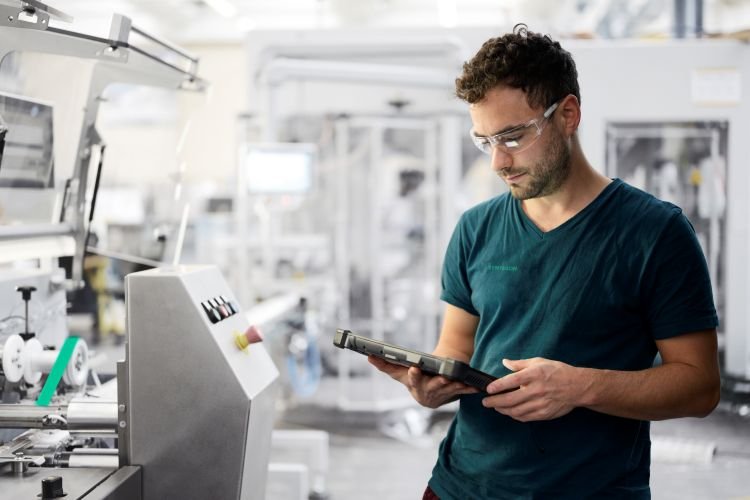
Modern automation systems combine sensors and artificial intelligence (AI) to perform complex tasks. AI-based quality control precisely detects deviations and indicates in real time where a problem has occurred and how it needs to be resolved. These technologies can help address labor shortages by increasing productivity and maintaining high quality standards. The next stage of development on the path toward the Factory of the Future will see machines communicating with one another to correct process deviations directly, without operator intervention.
2. The Industrial Internet of Things (IoT)
The IoT connects machines and systems into a communicating network. Sensors continuously collect process data to enable real-time optimization, while predictive maintenance makes it possible to identify potential problems before they cause disruptions. This connectivity lays the foundation for autonomous production systems.
3. Data-Driven Production
The foundation for this is data. Analytics tools transform raw data into actionable insights that support decision-making at every level. Edge and cloud computing provide the necessary technical infrastructure. This approach not only enables the optimization of existing processes but also opens up new business models.
4. Sustainability as a Core Principle
Sustainability is an integral part of modern production. Intelligent control systems optimize energy consumption, resource-efficient solutions reduce material usage, and circular economy approaches minimize waste. In this way, environmental responsibility can be combined with economic benefits – reducing costs, meeting regulatory requirements, and strengthening brand reputation.
5. Flexibility and Scalability
Adaptable systems enable rapid product changeovers, while modular equipment provides future-proofing. New technologies can be integrated, and systems can be scaled easily without requiring a complete rebuild.
These five pillars form an integrated overall concept that connects innovation with strategic business objectives. Syntegon supports food manufacturers in integrating different automation concepts into their specific production environments.
The Factory of the Future as a Continuous Process
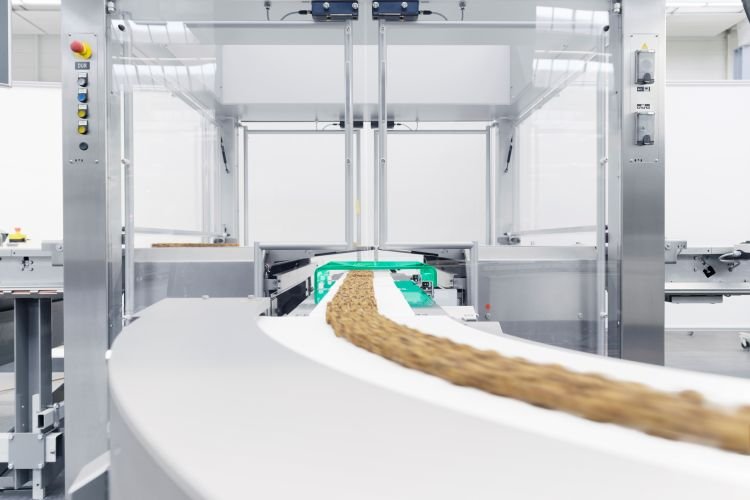
The Factory of the Future is not a fixed destination, but rather a process of continuous development. Autonomous production lines are already a reality in companies today. Self-optimizing processes that independently respond to changing conditions and continuously improve their own performance are on the verge of a breakthrough.
This is precisely where the neXt system architecture comes into play. As an integrative approach, it connects machines, seamless operating concepts, and AI- and data-driven decision support to create a holistic ecosystem. The goal is not simply to automate production processes, but to make them seamless, intelligent, and increasingly touchless. This makes neXt a central building block for the next stage in the evolution of food production.
Sustainability is being driven further by innovative materials, new technologies, and growing demand. Bio-based packaging materials, energy-self-sufficient production systems, and closed-loop resource cycles are key areas of development. Data-driven services, predictive maintenance as a service, and flexible production capacity on demand are transforming value chains.
Syntegon is actively shaping this future through its own research and development activities and close collaboration with customers and partners. The goal is to develop technologies that are not only highly innovative, but also economically viable and sustainable. The intelligent connection between people, machines, and data to enable efficient, sustainable, and future-ready production lies at the heart of the Factory of the Future. This vision represents the future that Syntegon is shaping together with its customers.
About Syntegon
Syntegon is a leading global technology company and strategic partner to the pharmaceutical, biotechnology and food industries. With a strategic focus on the growing pharmaceutical and biotechnology sectors, Syntegon plays a vital role in global healthcare. The company provides in-depth process expertise and mission-critical technologies for the safe, efficient and compliant production of essential medicines. In the food industry, Syntegon is known for its high-speed and high-precision packaging solutions that help manufacturers increase efficiency and product quality. With its global service business, the company supports around 75,000 installed systems through a comprehensive lifecycle offering that safeguards uptime, efficiency and long-term value.
In the 2024 fiscal year, Syntegon generated revenue of €1.6 billion. Headquartered in Stuttgart, Germany, the company employs 6,900 people at 47 locations in more than 20 countries. Drawing on more than 160 years of industrial expertise, Syntegon delivers solutions that make a meaningful difference, helping people live better, stay healthy and trust the products they rely on every day.