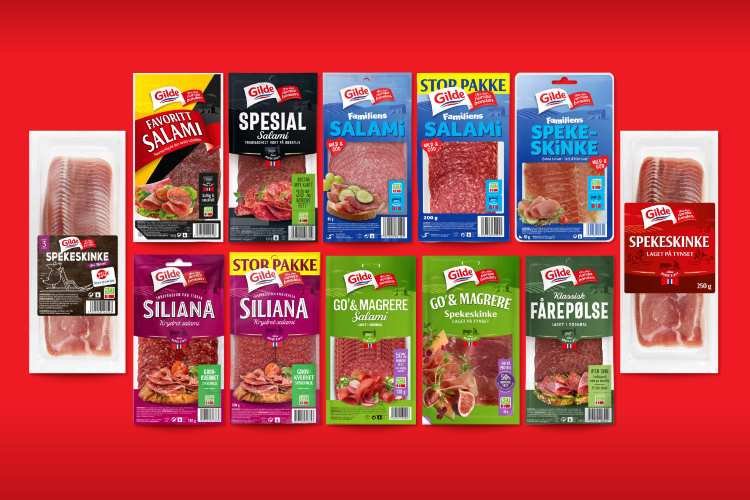
Nortura is continually working to make its packaging more environmentally friendly. Last year, the company replaced its existing multilayer-laminate packaging concepts for sliced salami and cured ham with material-efficient, PP-dominant packaging solutions from SÜDPACK, designed for material recycling. In this product segment alone, the switch has reduced annual plastic consumption by a total of 45 metric tons per year.
Nortura SA is Norway’s largest producer of meat and eggs. The industrial group is a cooperative owned by 15,200 Norwegian farmers and has established Gilde and Prior as two strong retail brands. With around 5,000 employees representing 70 nationalities it operates across the country and processes 230,000 metric tons of food each year. Their products are part of approximately 300 meals per person every year. Nortura’s stated goal is to support agriculture so that “healthy food can be produced with future generations in mind, using Norwegian resources and drawing on the country’s natural environment,” explains Alexander Baustad, Head of Packaging Development.
Ready today for tomorrow’s requirements
Working closely with film manufacturer SÜDPACK, Nortura has completely redesigned the packaging solutions used for its popular GILDE sliced meats – with measurable results. The project focused on two key objectives: reducing plastic use and ensuring recyclability so that, after use, the packaging can enter Norway’s existing sorting and recycling streams. By replacing conventional PA/PE- and PET-based multilayer laminates with PP-dominant mono-material structures, Nortura is reducing the environmental impact of its packaging over the long term while supporting Nortura’s preparations for the forthcoming PPWR requirements.
Before and after: A closer look at salami packaging
Nortura’s previous packaging solution for sliced salami consisted of PA/PE multilayer laminates – specifically, a 230 μm bottom web and a 75 μm top web. Total plastic use in this segment amounted to approximately 126 metric tons per year.
The new packaging concept combines a 250 μm bottom web from the Ecoterm range with SÜDPACK’s SafePeel PurePP top web, which is just 60 μm thick. Replacing the conventional material, which offered limited recyclability, with the PP-dominant alternative reduces the weight of plastic per package by approximately 13% due to the lower material density of polypropylene (PP). Overall, this amounts to an annual reduction of around 19 metric tons of plastic, including production waste. The package is designed for material recycling and has a PP content of approximately 95.6%.
Sliced cured ham
The packaging footprint for GILDE sliced cured ham improved even further: Switching from PET-based multilayer laminates to a PP mono-material solution across all formats reduced annual plastic use by 28.3%, or 17.2 metric tons, from the previous total of 61 metric tons. For certain formats, including the long packs used for sliced cured ham, optimizing the pack dimensions reduced plastic use by as much as 36%.
Once again, SÜDPACK’s experienced extrusion specialists selected the proven combination of Ecoterm PP and SafePeel PurePP. Compared with the salami packaging, further refinements to the package design allowed the thickness of both the bottom and top webs to be reduced considerably – from 350 and 83 μm to 250 and 60 μm, respectively – without compromising pack stability or performance.
Teamwork and technological innovation are key to success
Overall, Nortura reduced plastic use for its sliced salami and cured ham product range by around 45 metric tons in 2025. At the same time, all packaging for these products was redesigned for recycling – a crucial step toward a functioning circular economy.
“This transformation is the result of extensive development work,” emphasizes Alexander Baustad. “Close collaboration with development partners such as SÜDPACK, systematic testing, and targeted modifications to existing production equipment have enabled us to balance sustainability, functionality, and economic profitability – without compromising product protection, quality, or shelf life.”
All of these factors are extremely important to Nortura. SÜDPACK’s new PP-based MAP packaging therefore incorporates high oxygen and water vapor barriers, maintaining the required shelf life across the relevant product range. Antifog properties also ensure an attractive presentation at the POS by keeping the sliced meats clearly visible and looking fresh and appetizing.
High efficiency and maximum reliability – plus greater cost-effectiveness
The recyclable packaging concepts also deliver impressive technical performance. SÜDPACK’s PP-based high-performance films run reliably and efficiently on Nortura’s existing thermoforming packaging lines. At the start of the project, Nortura had been concerned that the new material structures might require investment in new machinery, but SÜDPACK quickly put those concerns to rest. Although PP films are generally more challenging to process because of the polymer’s specific properties, they run smoothly at Nortura’s plants following only some adjustments. They also match around the same throughput of the previous materials. The reduced material thickness of the top film from 83 µm to 60 µm offers the Norwegian meat processor an additional benefit: approximately 38% more running meters per reel. This means fewer reel changes, less downtime, and lower logistics costs.
The precisely matched bottom and top webs also ensure reliable processing and packaging performance. The bottom webs combine excellent thermoforming performance with high dimensional stability. The packaging system ensures a reliable seal between the top and bottom webs, while SafePeel PurePP’s excellent peel properties make the package easy for consumers to open.
From expertise to measurable results and lasting success
The results have already impressed the jury of the Plastic Pledge Awards, which recognizes companies annually for specific, documented packaging initiatives that contribute to more circular and sustainable plastic packaging. In 2026, Nortura’s salami and cured ham packaging won both the “Design for Recycling” award and the “Shelf-life Award.”
Nortura’s packaging development and production teams are particularly proud of this recognition. They also recognize that the success of such a complex project depends primarily on technology, teamwork, and testing – lots of testing. “Although SÜDPACK is a long-standing partner that understands our requirements, has extensive expertise in developing material-efficient, recyclable high-performance films, and knows how to achieve a fast time-to-market, extensive testing is still essential,” explains Alexander Baustad. Testing ranged from initial material trials at SÜDPACK’s Application Center in Ochsenhausen to multiple runs in Nortura’s production environment to verify that the selected materials would run reliably on the existing thermoforming machines at the required cycle rates.
Building on its success, Nortura is now accelerating its efforts: All product packaging shell gradually be adapted to meet the applicable PPWR requirements regarding recyclability.