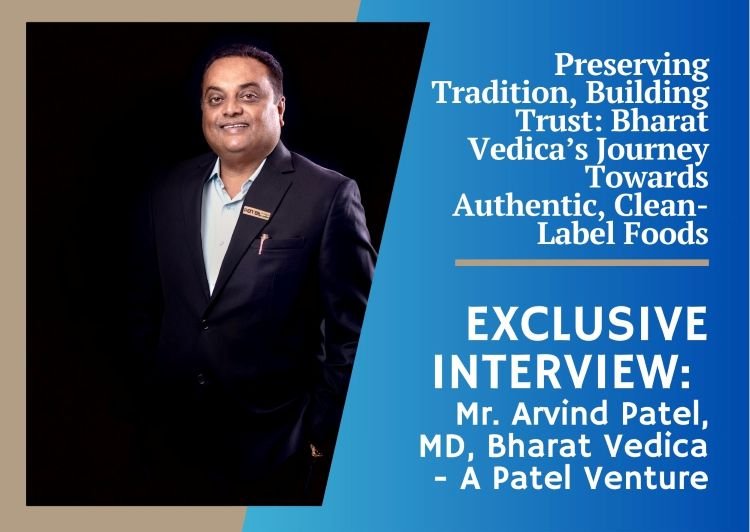
In an exclusive interview with Food, Drink & Innovations, Mr. Arvind Patel, Managing Director, Bharat Vedica – A Patel Venture, shares his vision of preserving India’s rich agricultural and culinary heritage through authentic ingredients, traditional processing methods and responsible sourcing. From Bilona-churned A2 Gir Cow Ghee and wood-pressed oils to stone-milled flours, organic millets, grains and pulses, Bharat Vedica is building its portfolio around the philosophy of the “Art of Slowing Down”, focusing on purity, patience, transparency and natural processes. Mr. Patel discusses the brand’s approach to quality assurance and farm-to-consumer traceability, its partnerships with smallholder farmers, sustainability initiatives and the growing consumer preference for clean-label and minimally processed foods. He also shares insights into Bharat Vedica’s expansion across D2C, e-commerce, quick commerce and modern retail, along with his outlook on the evolving premium organic and traditional foods market in India.
Q1. Overview of the brand, product portfolio, and the philosophy behind preserving India’s agricultural heritage.
For years, I found it hard to buy food that tasted the way it did when I was growing up on our family farm, honest and free of chemicals. In 2022, we decided to create Bharat Vedica to bring back that purity, starting with A2 Gir Cow Ghee made from the milk of our own Gir cows using the traditional Bilona method.
At the heart of Bharat Vedica is the philosophy we call the “Art of Slowing Down.” In a world driven by speed, we choose to work in harmony with nature’s pace ,respecting the soil, honouring traditional methods, and refusing to compromise on quality. We believe that good food takes time, and it is this patience, care, and commitment to authenticity that form the very soul of the brand.
Today, our portfolio includes everyday Indian pantry essentials such as A2 Gir Cow Ghee, Wood-Pressed Oils, Raw Forest Honey, Stone-Milled Flours, Organic Millets, Grains, and Pulses. As life became busier, food turned into something we rushed through rather than something we truly cared about, and along the way it quietly lost the purity and authenticity it once had. Through Bharat Vedica, we are working to bring back traditional Indian food in its purest form, treating our farming heritage not as nostalgia but as a legacy worth preserving and carrying forward for the next generation.
Q2. How do traditional methods like Bilona churning, wood pressing and stone grinding help retain nutritional quality and differentiate your products?
The difference lies in how the ingredient is processed. Our A2 Gir Cow Ghee is made using the Bilona method, where curd is hand-churned and slowly clarified instead of being processed from cream at high speed, which is what gives it its aroma, grainy texture and easy digestibility. Our oils are wood-pressed at low temperatures, so the natural nutrients, antioxidants and flavour of the seed stay intact instead of being lost to heat. Our flours are stone-milled, which keeps the grain cool as it is milled and holds on to the fibre and natural oils that fast, high-heat milling tends to strip away.
When food is processed using high heat, much of its natural goodness, aroma, and character can be lost. Traditional methods help preserve these qualities. Wood-pressed oils retain their natural fragrance and beneficial fats, while stone-milled flours preserve more of the grain’s inherent qualities. At Bharat Vedica, the focus is on bringing these time-honored methods into modern kitchens through clean packaging and transparent labelling.
Q3. What systems and quality assurance protocols ensure transparency, certification, and product integrity from farm to consumer?
Trust is everything in this category, and it has to be earned with proof rather than words. Our ghee undergoes rigorous testing across 15+ quality parameters and quality checks to verify its purity, authenticity, and safety. We ensure each batch is cleared against strict food-safety standards before it reaches a customer. We work with certified organic sourcing and document our processes so we can genuinely stand behind what is printed on the label.
Being honest about how a product is made matters just as much. We tell people exactly what the ingredient is, where it comes from, and how it was processed and packed, and our packaging carries that information. For us, authenticity is not a certificate you frame on a wall. It is a discipline you follow every single day, in small batches, holding the same standard whether one jar is being made or a thousand. That consistency,over time, is what builds real confidence in a household.
Q4. How has Bharat Vedica built a reliable sourcing network with smallholder farmers while maintaining consistency, quality and scalability?
This is honestly the hardest and most rewarding part of the business. Working with smallholder farmers is nothing like buying from a large commodity supplier. Every farm is different, and nature does not follow a fixed schedule. We have built our network slowly and personally.
What holds it together is a shared standard. We are clear with our farming partners about how we want a crop grown and handled using sustainable practices, and in return we offer them a stable, fair and ongoing association. Quality checks begin at the sourcing stage, not just the factory, because purity cannot be fixed later. Growing this way is slower than mass procurement, and we have made peace with that. We would rather protect consistency than expand quickly and compromise the very thing our customers rely on us for.
Q5. What shifts are you seeing in consumer behaviour around clean-label and minimally processed foods, and how is that shaping your innovation and strategy?
The biggest change is that people are asking the right questions about what they eat. A few years ago, the word “organic” on a pack was enough. Today a customer turns the pack over, reads the ingredient list, and wants to know how the product was actually made. The move from blind trust to informed choice is the finest thing that could have happened to this category, and it holds us to a higher standard. As today’s consumer values clean-label, minimally processed food, our purpose is not to process more, but to preserve more. It guides everything we create: products that belong in a traditional Indian pantry, never those that chase a trend. More than anything, it has answered a question we long carried within. People are not looking for the cheapest food, but for food they can trust, and once that trust is earned, price ceases to be the question.
Q6. What initiatives has Bharat Vedica undertaken to strengthen environmental sustainability while supporting farming communities?
For us, sustainability isn’t a campaign we run on the side. It is reflected in the way our crops are grown, our ingredients are sourced, and our products are processed. We encourage farming practices that minimise the use of chemical pesticides and fertilisers, helping preserve soil health while producing cleaner, high-quality agricultural produce.
Our traditional processing methods are equally important to this approach.
Techniques such as wood pressing and stone milling use traditional, low-intervention methods that help preserve the natural integrity of ingredients while supporting a more considered approach to production.
Bharat Vedica is steadily transitioning to reusable packaging materials such as glass and steel that help preserve product quality while being more considerate of the environment. Beyond packaging, the brand views sustainability as a commitment to the people behind its products. By building fair and dependable relationships with its farming partners, Bharat Vedica helps preserve traditional agricultural practices while supporting rural livelihoods. The brand believes that true progress should benefit the communities it works with, creating lasting value that extends far beyond the products themselves.
Q7. With expansion across D2C, e-commerce, quick commerce and modern retail, what are your growth priorities, and how do you see the future of India’s premium organic and traditional foods market?
Our first priority is to be wherever the consumer naturally looks for us, without diluting who we are. We started direct-to-consumer, and we are now present across E-commerce, Quick commerce and modern retail. Each channel plays its own role. D2C lets us tell our full story, marketplaces give us reach, quick commerce meets everyday needs, and a retail shelf builds familiarity and trust in person.
But distribution alone is never the goal. What matters is that the product and the promise stay identical everywhere they appear. Looking ahead, we believe India’s premium organic and traditional foods market will keep maturing from a niche into a considered, everyday choice, especially as younger, health-aware consumers in both metros and smaller towns step in. As the market grows and it needs change, we are evolving as a brand too, meeting people through new channels and formats while holding onto what does not change. Our preparation for that is not complicated. Keep the food natural in its essence keep the process traditional, and keep earning trust one household at a time.